
Acquiring Artwork
All works listed on this site are available for purchase unless otherwise noted.
If a piece resonates with you, I warmly invite you to reach out. Collecting art is a personal and meaningful process, and I’m always happy to answer questions, share additional details, or discuss next steps at a comfortable pace.
To inquire about a specific work, please email celloeye@gmail.com and include the title of the artwork in the subject line. I respond personally to all inquiries.
There is no obligation to purchase—conversations are always welcome.
How to Inquire
If you’re unsure what to write, you’re welcome to use the guide below:
Subject: Inquiry about [Title of Artwork]
Message:
Hello Daniel,
I recently viewed [Title of Artwork] on your website and felt drawn to it. I’d love to learn more about the piece, including availability, shipping, and next steps.
Thank you,
[Your Name]
Collector FAQ
Your Dangerous Upon the Lips, My Unicorn
Acrylic on linen canvas, 32 × 40 in.
$3,000
Collection of the artist — inquire for purchase: celloeye@gmail.com
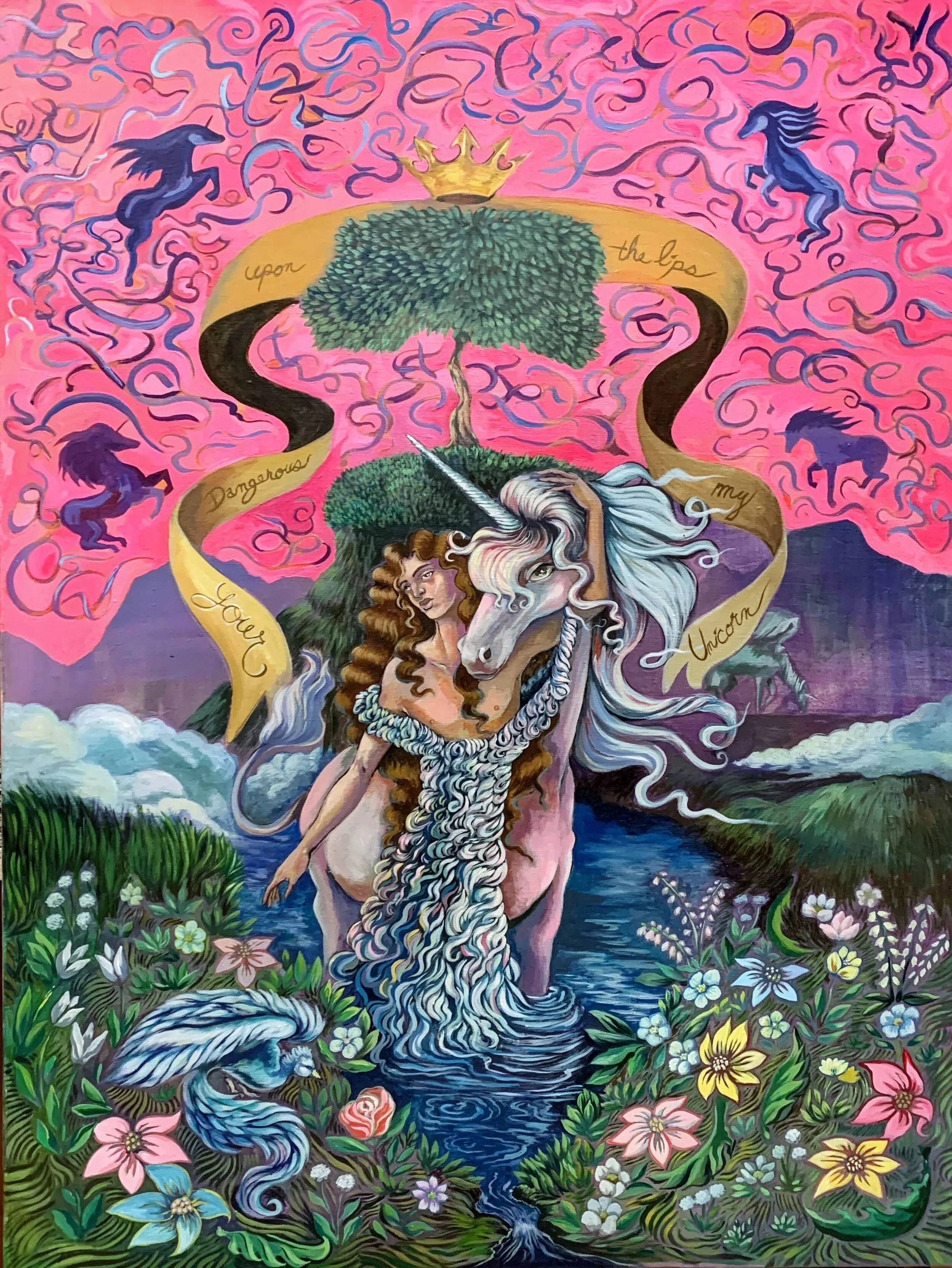
Your Dangerous Upon the Lips, My Unicorn is a deeply personal work born from a song I wrote titled Unicorn—a lament on rejection, longing, and the peril of believing too fiercely in a love that cannot return itself. The painting gives visual form to the moment of reckoning: discovering that the creature once believed to be rare, magical, and impossible to lose is, in fact, capable of wounding.
In the mythology of the piece, the unicorn represents an idealized beloved—someone imagined as singular and irreplaceable, a being I believed might never exist for me again if lost. There is both devotion and resignation in this belief: a quiet acceptance that solitude might be the cost of loving honestly. When the unicorn does not return that love, its beauty becomes dangerous, its presence breaking the heart it once inspired.
The water nymph rising from the river is myself—a sensitive, fluid being shaped by emotion, vulnerability, and repetition. As a water sign, the nymph embodies openness and feeling, forever susceptible to injury yet incapable of hardening. She emerges not in defeat, but in acknowledgment of pain as part of her nature.
Drawing inspiration from medieval tapestries, the composition is filled with ornate botanical forms and fantastical birds. These birds—unbound and radiant—serve as quiet witnesses and symbols of freedom, untouched by repression or emotional constraint. They hover above the scene as a counterpoint to heartbreak, offering solace and possibility. The river itself becomes a place of renewal, where sorrow is held, released, and transformed.
This painting is both elegy and survival—an intimate meditation on desire, fragility, and the courage it takes to remain open, even after love has proven dangerous.
Crucify Myself / Golden Cristos
2018
Acrylic and mica flakes on canvas, 22 × 28 in.
$2,500
Collection of the artist — inquire for purchase: celloeye@gmail.com
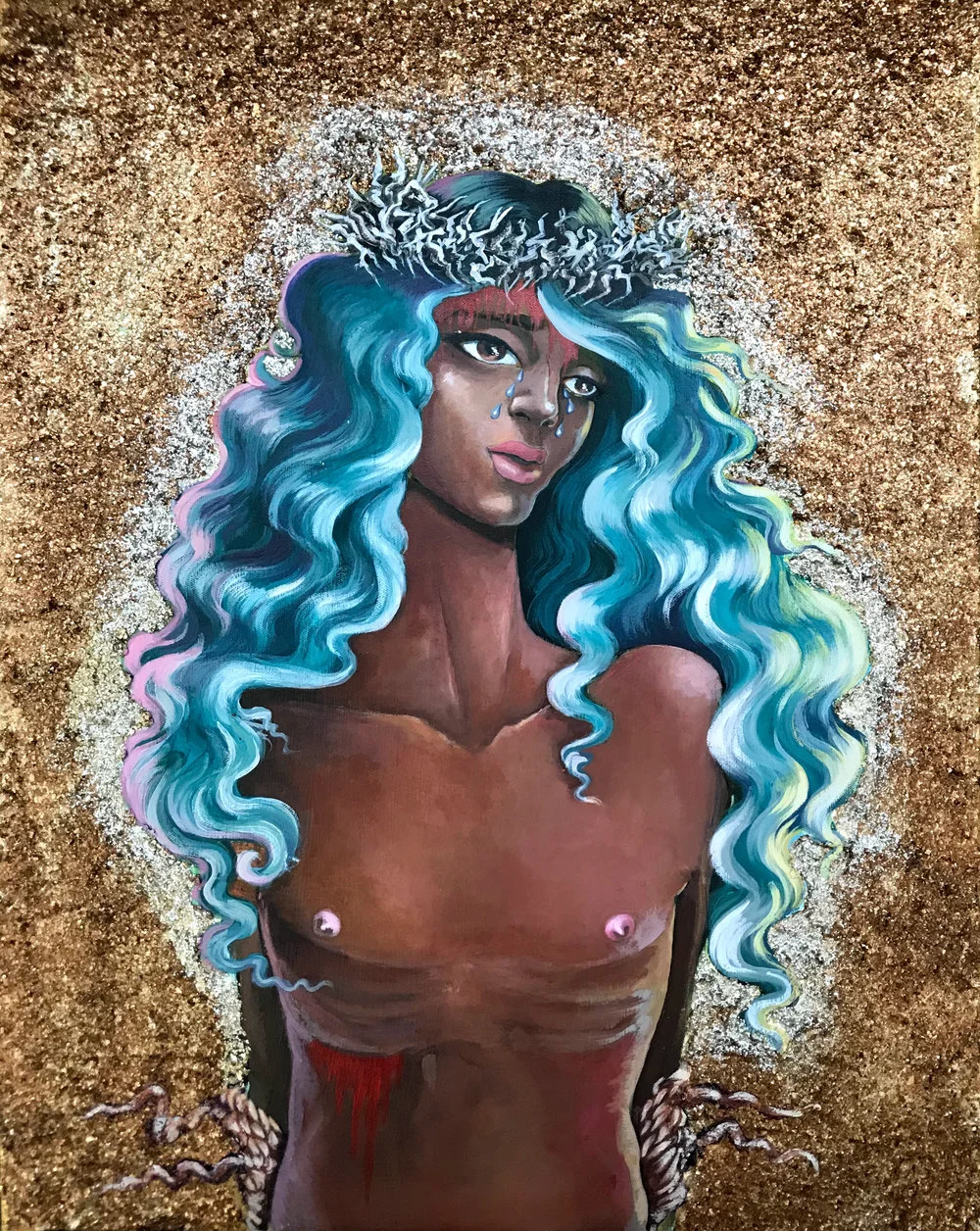
I Crucify Myself / Golden Cristos is a contemplative and confrontational work inspired by Orthodox iconography and by contemporary movements within LGBTQ+ Catholic communities that reclaim Christ as a queer figure. The painting poses a series of theological and emotional questions rather than offering definitive answers: What if Christ was queer? What if queerness itself is divine?
Christ is presented here not solely as the suffering Son of God, but as a figure of radical otherness—an asexual, liminal being whose life was defined by devotion, mystery, and profound intimacy with those cast outside the dominant order. The work imagines the disciples as a collective of seekers—men bound not only by faith, but by shared longing and difference—drawn to Christ as a mirror through which they might understand their own queerness and spiritual identity.
The figure of Christ is rendered with luminous golden skin against a shimmering field of mica flakes, amplifying his divinity and otherworldly presence. Gold functions both as sacred material and as provocation, echoing the visual language of icons while destabilizing their fixed meanings. His long, quiffed blue hair introduces a further rupture—an intentional deviation from canonical imagery that underscores fluidity, beauty, and defiance of prescribed form.
The title, I Crucify Myself, speaks to the internalized violence often experienced by queer people within religious structures: the act of loving, believing, and existing in bodies and identities deemed transgressive. Yet within this crucifixion there is also reverence, transformation, and self-recognition. The work holds tension between devotion and resistance, sanctity and rupture, suffering and transcendence.
This painting is both icon and inquiry—a devotional image reimagined through queer theology, inviting viewers to reconsider holiness as expansive, embodied, and gloriously unresolved.
Salvator Mundi
2018
Acrylic on canvas, 24 × 30 in.
$2000
Collection of the artist — inquire for purchase: celloeye@gmail.com
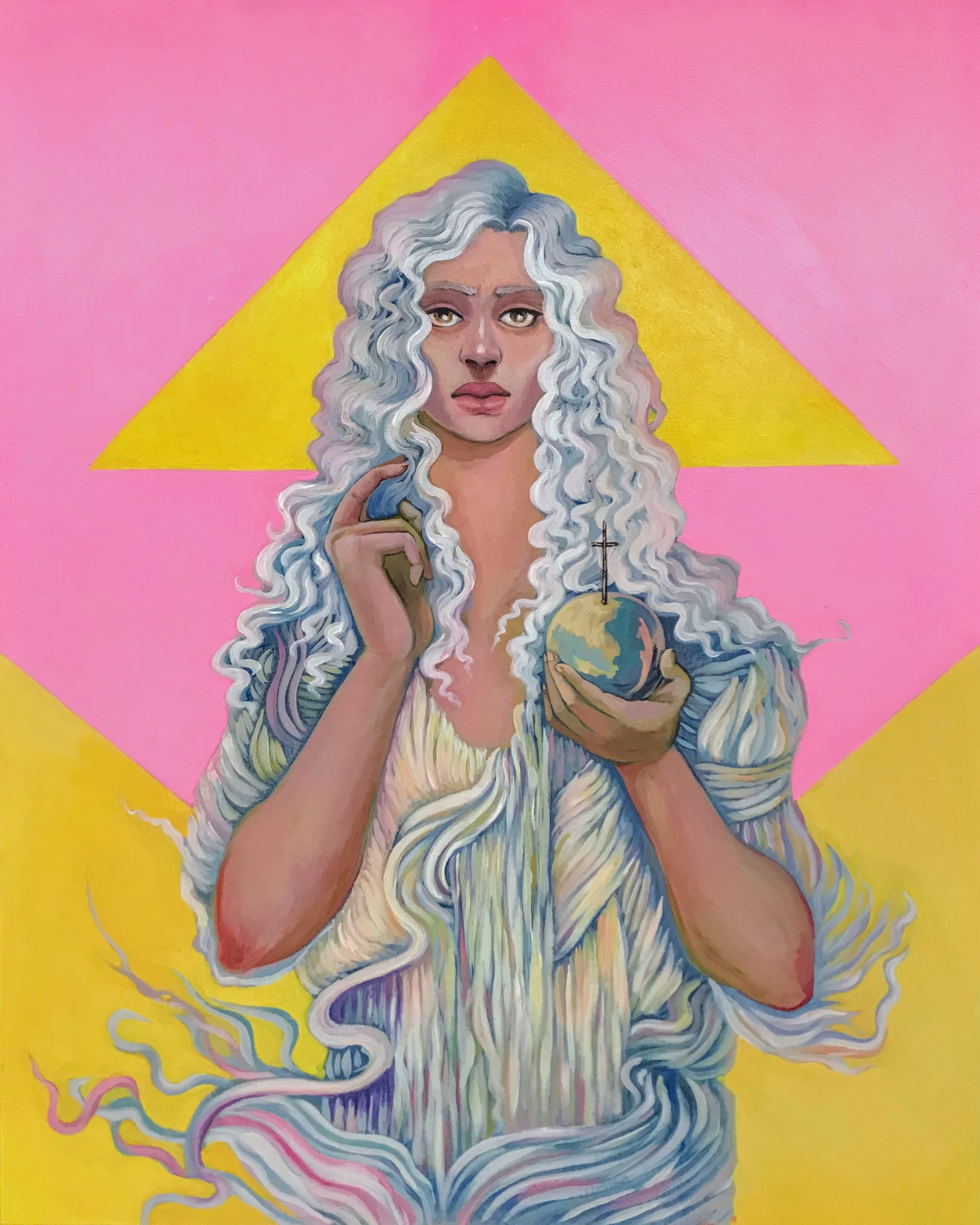
Salvator Mundi continues my ongoing exploration of Christ as an intimate, reclaimed figure—one that resonates deeply with questions of identity, authenticity, and spiritual survival. As with my Golden Cristos works, this painting presents Christ not as a distant icon, but as a mirror through which personal and collective liberation can be examined.
In this reimagining, Christ’s halo takes the form of a pink triangle—a symbol first used by Nazi Germany to mark homosexual men, later reclaimed by ACT UP and other activist movements during the AIDS crisis as a sign of resistance, visibility, and solidarity. By placing this symbol at the center of a sacred image, the painting forges a deliberate parallel between the figure of the savior and the radical power of the authentic self. Salvation here is not only cosmic—it is personal: the act of saving oneself from repression, from silence, from disease, and from the fear imposed by others.
The work is also informed by the controversy surrounding the alleged rediscovery of Salvator Mundi by Leonardo da Vinci. The debate over the painting’s authenticity—whether it is truly a Da Vinci or a product of another hand—became a metaphorical lens for this work. What does it mean to be “the real thing”? Who decides authenticity, and by what authority? These questions echo powerfully within queer experience, where identity is often scrutinized, challenged, or denied.
Through this convergence of art history, queer symbolism, and spiritual inquiry, Salvator Mundi becomes both portrait and proposition. It asks the viewer to consider salvation not as conformity or obedience, but as self-recognition—an act of courage that affirms truth, complexity, and presence in the face of doubt.
Montserrat
2014
Acrylic on canvas, 29.5 × 64 in.
$5,000
Collection of the artist — inquire for purchase: celloeye@gmail.com

Montserrat is part of my ongoing series Madonna Reconstructed, in which each painting reinterprets a Marian image that has been deeply influential in Latin America and the Caribbean. The series operates from the premise that I am both artist and artisan—assembling the visual language of my own time to propose a new iconography, a contemporary dogma shaped by lived experience rather than inherited authority.
This work draws from the histories and legends surrounding the Virgin of Montserrat and her appearances across the Caribbean, particularly the Puerto Rican practice of “discovering” sacred images within carved saints. Traditionally, Montserrat is depicted holding the Christ child who bears the world in his hand—a composition that often presents Montserrat as a Black woman caring for a white Christ child. This imagery has long echoed the colonial archetype of the Black or Afro-Caribbean caretaker nurturing the master’s child, a visual metaphor layered with devotion, power imbalance, and imposed identity.
In my reimagining, Montserrat becomes a mulatta woman—a figure of mixed race, reflecting both my own identity and the evolving reality of the Caribbean. She is neither servant nor symbol of subjugation, but a sovereign presence. Her garments are inspired by the dramatic, sculptural fashion of Alexander McQueen, merging haute couture with sacred iconography. This fusion places the Madonna firmly in the present: modern, commanding, and unapologetically powerful.
Montserrat proposes a vision of holiness rooted in hybridity and transformation. It honors tradition while refusing its limitations, offering an image that speaks to contemporary Caribbean identity—complex, layered, and self-defined. The painting invites viewers to reconsider who is allowed to be sacred, who is centered in devotional imagery, and how faith evolves when reclaimed by those once rendered peripheral.
Pandora’s Aquarium
2018
Acrylic on panel, 18 × 24 in.
$2000
Collection of the artist — inquire for purchase: celloeye@gmail.com
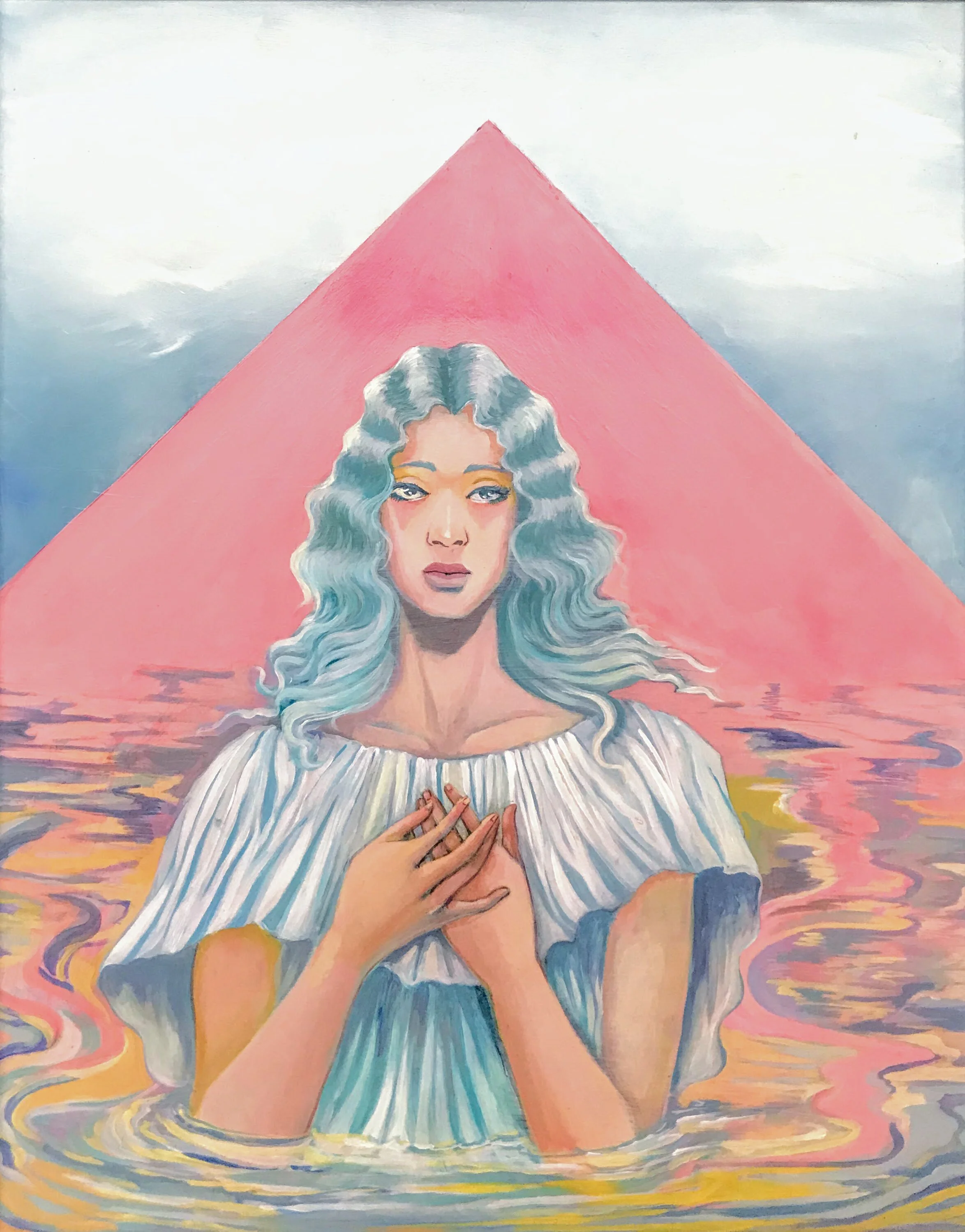
Pandora’s Aquarium is a fantasy image inspired by the song Tori Amos Pandora’s Aquarium, unfolding as a meditation on power, spectatorship, and the consumption of vulnerability. The painting imagines a surreal landscape of pink mountains receding into the distance, where a ziggurat dissolves into water—architecture, history, and authority melting into an unstable, submerged world.
At the center of the composition is Pandora herself, swimming within an aquarium. This enclosed, transparent space becomes both refuge and prison: a site of display where the body is visible, contained, and observed. The aquarium implicates the viewer—and by extension, society—as watcher. Who benefits from looking? Who controls the glass? The work echoes Amos’s critique of how women’s pain, sexuality, and interior lives are rendered consumable, aestheticized, and safely distanced behind a barrier.
The title anchors the work’s conceptual tension. Pandora, the mythic figure eternally blamed for releasing suffering into the world, is reimagined here not as a perpetrator but as a subject under scrutiny. The aquarium reinforces this misattribution of guilt: a fragile ecosystem where life survives under constant observation, its freedom conditional and precarious.
Pandora’s Aquarium operates as both myth and metaphor—an image of beauty shaped by constraint, and a quiet act of resistance against narratives that punish women for curiosity, desire, and truth. The painting invites viewers to reflect on their own role within systems of looking, judgment, and control, and to question where power truly resides: with the one on display, or the one doing the watching.
Vírgen de La Rosa
2014
Acrylic on panel 15 × 22 in.
$1200
Collection of the artist — inquire for purchase: celloeye@gmail.com

Vírgen de La Rosa is part of my ongoing series Madonna Reconstructed, in which I reinterpret Marian images that have shaped Latin American and Caribbean identity. In these works, I approach the Madonna not as a fixed religious symbol, but as a living icon—one continually translated, adapted, and reimagined by the communities that venerate her.
This painting draws from the devotional image of Rosa Mystica, a Marian title associated with prayer, sacrifice, and penitence. Rather than replicating traditional iconography, I position myself as an artisan and interpreter, much in the way Indigenous and Afro-Caribbean artists historically absorbed and reshaped Catholic imagery through their own cultural lenses. The result is not imitation, but transformation.
The Virgin appears doll-like, echoing the aesthetics of the Cuzco School and polychromed wood santos. Her stillness, frontal gaze, and jewel-like surface evoke both intimacy and distance—an eternal presence that exists beyond time. The panel itself plays an active role in the image, a practice influenced by my encounter with Puerto Rican artist Antonio Martorell, whose approach to material emphasized dialogue over domination. Like Martorell, I allow the surface to guide the work, engaging in a quiet conversation with the medium rather than imposing control.
My relationship to Marian imagery is also deeply personal. Raised in a conservative evangelical church in North Philadelphia, I was taught to reject the Virgin Mary as idolatry. It was only later—through art, history, and lived experience—that I came to understand her significance as muse, goddess, and cultural mirror within Latin American traditions. Across the Americas, the Madonna has evolved to reflect Mestizo, Indigenous, African, and mixed identities, absorbing pre-Christian beliefs and local histories into her form.
In Vírgen de La Rosa, I honor that evolution. This is not a Virgin bound to colonial narratives, but one shaped by hybridity, empathy, and continuity. She looks past the viewer with a calm, unwavering presence—an image of devotion that is both inherited and newly made. The painting invites reflection on faith as a process of translation, and on the Madonna as a site where identity, memory, and longing converge.
The Bird Cage: An Analysis on Repression
Acrylic on panel, 16 × 20 in.
$1,300
Collection of the artist — inquire for purchase: celloeye@gmail.com

The Bird Cage: An Analysis on Repression is one of the earliest paintings I created while simultaneously working on my album Kyrie. At the time, both the music and the visual work were born from recurring internal conversations—acts of self-consolation shaped by fear, protection, and survival.
The image emerged from a persistent metaphor I carried for many years: the belief that suppressing my homosexuality was a form of safety. I convinced myself that concealment protected not only me, but also my family—that hiding was an act of care. In this way, repression became a self-constructed shelter. The cage was not imposed from the outside; it was built lovingly, intentionally, and with the hope that it would keep everyone safe.
Within the painting, the cage is rendered not as a harsh prison, but as a birdhouse—soft, intimate, and deceptively comforting. The central figure, with long blue hair and eyes welling with emotion, gently strokes a feather. This gesture becomes a moment of contradiction: a ritual of reassurance paired with a quiet recognition of loss. The feather symbolizes potential—the possibility of flight, of authenticity, of a life lived fully—while the figure continues to convince themself that remaining enclosed is the wiser choice.
Feathers recur throughout the work as symbols of beauty, softness, and luxury. They carry associations with adornment, effeminacy, and drag—qualities I worked hard to suppress in order to survive. Denying gender fluidity and queerness became a safety net, even as it narrowed my sense of self. Inside the cage, a bird huddles, visibly too large for the space it occupies. Its body presses against the limits of confinement, embodying the quiet violence of a life forced to shrink.
The painting does not judge repression—it seeks to understand it. For many people, self-suppression is a strategy of protection in environments that deem authenticity dangerous, polarizing, or unacceptable. Yet The Bird Cage also acknowledges the cost of this protection: the distortion of one’s vision, the erosion of possibility, and the grief of a life lived smaller than it needs to be.
This work is both confession and reflection—a tender examination of how safety can become captivity, and how the most beautiful cages are often the hardest to leave.